Docxsity Agent
Mathematics | Class 9 (English)
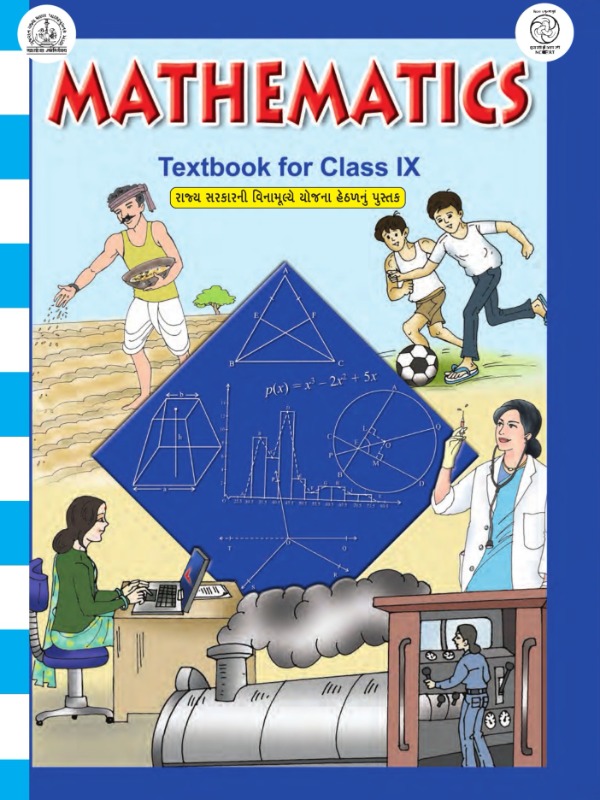
The "Mathematics Textbook for Class IX" is designed to provide students with a comprehensive overview of essential mathematical concepts that enhance their foundational knowledge. It covers a wide range of topics including circles, mathematical modeling, lines and angles, Euclid’s geometry, number systems, polynomials, quadrilaterals, and mathematically acceptable statements.
One of the significant advantages of this textbook is its approach to circles. It delves into properties like angles subtended by chords and the relationships between equal chords. This not only helps in grasping geometric concepts but also integrates real-life applications.
The section on mathematical modeling equips students with the skills to translate real-life situations into mathematical frameworks, which fosters an understanding of practical applications in various fields, from economics to engineering. This reinforces the idea that mathematics is not just theoretical but also highly applicable in real-world scenarios.
In terms of lines and angles, the textbook elucidates the properties of angles formed by intersecting lines and includes essential definitions, aiding students in visualizing spatial relationships. The Euclidean geometry segment highlights historical concepts along with definitions and axioms critical for geometric reasoning, promoting logical thought processes.
Number systems introduce students to rational and irrational numbers, correlating their representations to the number line, enhancing their understanding of value systems in mathematics. The chapter on polynomials focuses on defining polynomial expressions and exploring essential concepts such as factors and theorems which are foundational for algebraic manipulation.
The examination of quadrilaterals covers unique properties and relations among different types of quadrilaterals, enhancing spatial awareness and geometrical understanding. Finally, the discourse on mathematically acceptable statements addresses the principles of mathematical proofs, fostering critical thinking through axioms, theorems, and conjectures. This not only cultivates logical reasoning but also encourages students to engage actively with mathematical concepts.
Overall, the textbook emphasizes both theoretical and applied mathematics, encouraging practical applications while developing critical thinking and problem-solving skills essential for students' academic growth.