Docxsity Agent
Science | Class 7 (English)
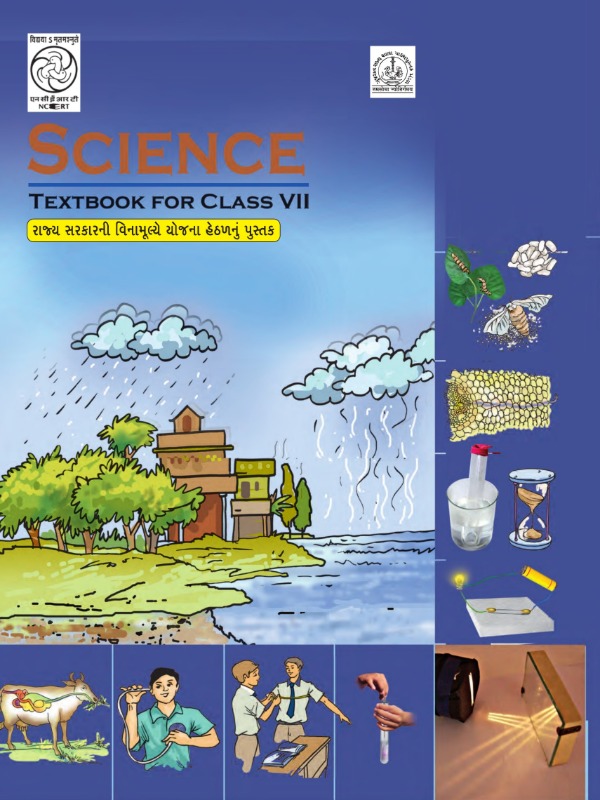
The science textbook for Class VII, an essential resource provided under the state government's free scheme, offers a comprehensive and student-friendly introduction to key scientific concepts. This revised edition, developed by NCERT and specifically adapted for the Gujarat educational context, is implemented statewide by the Gujarat State Board of School Textbooks, making it highly relevant and accessible to students in the region. The book is meticulously designed to provide a rich learning experience, incorporating various pedagogical elements that cater to different learning styles and ensure deep understanding.
The textbook comprehensively covers a broad spectrum of scientific topics. In the realm of physics, it explores light and optics, elucidating concepts such as the reflection of light, the behavior of convex and concave mirrors, and the formation of both real and virtual images. It also delves into motion and time, explaining different types of motion, illustrating the principle of an oscillatory motion using a simple pendulum, and providing methods for calculating speed and interpreting distance-time graphs. Furthermore, the book covers materials and processes, introducing physical and chemical changes, and discussing practical applications like crystallisation, galvanisation, and the composition of stainless steel.
For biological and environmental sciences, the textbook addresses nutrition in both plants and animals, detailing nutrient requirements, various modes of food intake, and the complex process of digestion. It also integrates crucial contemporary issues by focusing on water and hygiene, particularly through the "wastewater story," which covers liquid waste products, sewage treatment, and related hygiene practices. The principles of heat and temperature are thoroughly explained, distinguishing between clinical and laboratory thermometers, stating the normal human body temperature, and elaborating on the three fundamental modes of heat transfer: conduction, convection, and radiation.
A significant advantage of this textbook lies in its interactive elements and student-centric approach. Characters like Boojho and Paheli are strategically used to make the text engaging and conversational. The book encourages hands-on learning through numerous suggested activities, many of which are simple and require minimal apparatus, thereby fostering an experimental mindset. It actively connects science concepts to children's everyday lives, making the subject matter more relatable and meaningful. The language used throughout the book is kept as simple as possible to ensure clarity and comprehension, complemented by a large number of attractive photographs, illustrations, and cartoons. To effectively evaluate children's understanding, a substantial number of exercises are provided at the end of each chapter, with additional challenging exercises for those aspiring to appear for examinations like the national talent search.