Docxsity Agent
Social Science | Class 7 (English)
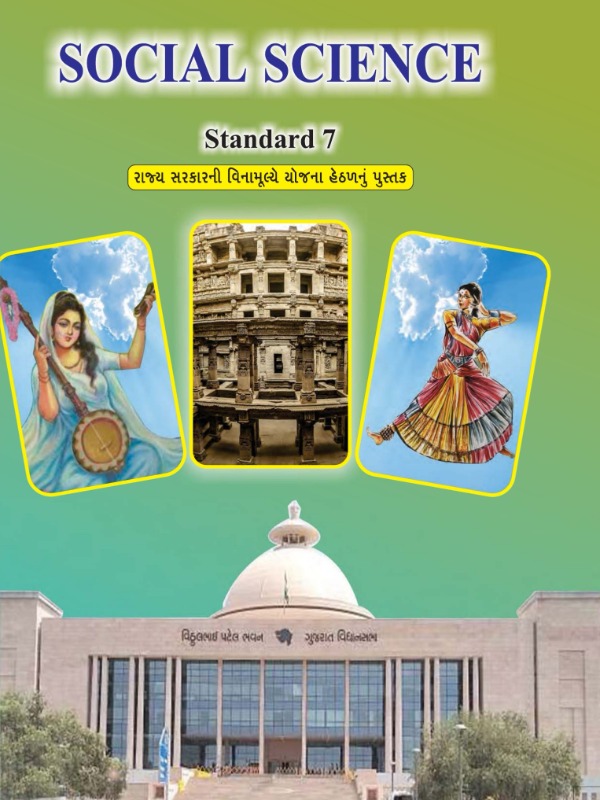
The textbook "Social Science, Std 7," prepared according to the new syllabus by the Gujarat Council of Educational Research and Training and approved by the state government, provides a comprehensive introduction to various fundamental concepts. This book is designed to be highly beneficial for students, teachers, and parents, as it includes brief material helpful to educators and exercises to ensure students properly consolidate their learning, thereby fostering fruitful classroom education. It aims to be an interesting, useful, and flawless resource for its readers.
The textbook significantly enhances students' knowledge of Earth science by detailing the planet's internal structure, describing it as having multiple layers. It covers the crust, identifying the continental crust as Sial (composed of silica and alumina) and the oceanic crust as Sima (made of silica and magnesium). Beneath this lies the mantle, and the innermost core, predominantly made of nickel and iron (Nife), characterized by extreme temperature, pressure, and density. Furthermore, the book elucidates the three main types of rocks—igneous, sedimentary, and metamorphic—explaining their formation processes and utilities, such as their use in roads, houses, and buildings.
Regarding environmental understanding, the book introduces the four primary components: the lithosphere, hydrosphere, atmosphere, and biosphere. The lithosphere, the Earth's solid crust, provides land for human settlement, agriculture, and raw materials. The hydrosphere encompasses all water sources crucial for living organisms, including oceans, seas, and rivers, which are also rich in resources. The atmosphere, a protective layer of air, absorbs harmful ultraviolet rays and enables sound transmission. The biosphere integrates these three, being the region where life is pervasive, providing necessities for flora, fauna, and human beings. The text also differentiates between natural and man-made environments, explaining how human intellect interacts with biotic and abiotic components to create the latter.
Moreover, the textbook emphasizes the critical importance of forests and mineral resources. Forests are highlighted as vital for human existence and progress, offering economic benefits through timber for furniture and sports articles, as well as products like lacquer, honey, and medicinal herbs. Beyond economic utility, forests hold significant environmental value by retaining moisture, aiding rainfall, conserving groundwater, preventing soil erosion, and maintaining the balance of oxygen and carbon dioxide in the atmosphere. Mineral resources, such as coal, natural gas, petroleum, iron, aluminum, gold, and uranium, are described as naturally occurring substances essential for mankind, serving as fuels, raw materials for diverse industries, and even in medicine, forming the backbone of the national economy and pillars of societal prosperity.
In the domain of governance, the textbook introduces students to structures like the state government, which is responsible for administering the state, maintaining law and order, and ensuring the welfare and safety of its people through legislative, executive, and judicial organs. It also explains local self-government, including rural bodies like gram-panchayats, taluka-panchayats, and district-panchayats, and urban bodies like municipalities and municipal corporations, allowing citizens to elect their representatives. This framework clarifies how the state government fulfills essential functions related to basic needs such as electricity, clean drinking water, health, and hygiene, and provides assistance during natural calamities.