Docxsity Agent
Social Science | Class 8 (English)
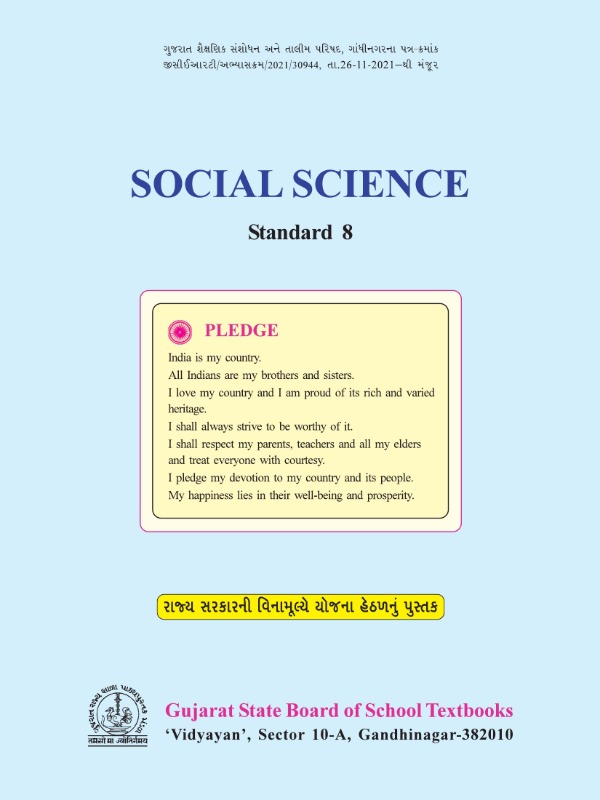
The textbook "Social Science, Standard 8" serves as a comprehensive educational resource, offering students an in-depth understanding of various critical aspects of Indian society and governance. It begins by meticulously outlining the significance of the Indian Constitution, which is distinguished as the longest written constitution globally. The text elaborates on India's democratic principles, defining democracy as "the rule of the people, by the people and for the people," where citizens participate in electing representatives every five years without discrimination. Furthermore, it clarifies the core tenet of secularism, asserting that the country is not governed by any single religious ideology and guarantees all citizens the freedom to follow and propagate their beliefs. The book also details fundamental rights, such as equality and freedom, alongside fundamental duties, which were notably incorporated into the constitution in 1976 AD, guiding civic responsibilities.
Additionally, the textbook provides a thorough examination of the Indian judiciary, detailing its hierarchical structure from taluka courts up to the Supreme Court, and its function in administering justice for both civil and criminal matters. It underscores the vital independence of the judiciary, which is constitutionally protected through stringent procedures for judge removal, ensuring impartiality. The Supreme Court, established on January 28, 1950, is positioned at the apex, with powers to enforce fundamental rights and ensure justice. The text highlights how this independent judiciary acts as a protector and guardian of the constitution, playing a crucial role in upholding civil rights.
Moreover, the resource delves into India's rich historical contexts, starting with the establishment of European and British rule, detailing the reasons for European arrival and the subsequent impact of British administrative systems and economic exploitation. It thoroughly covers the First War of Independence in 1857 AD, exploring its underlying political and socio-religious causes, and subsequently traces various freedom movements from 1885 AD to 1947 AD. This section provides insights into the emergence of nationalism, the formation of the Indian National Congress, the contrasting ideologies of moderate and radical leaders, and pivotal events such as the 'Quit India' movement, fostering a profound sense of national identity.
The book further showcases India's progress and global contributions through its post-independence achievements, particularly noting advancements in space technology, including the launching of satellites using vehicles like GSLV. It also recognizes the cultural significance of traditions such as Yoga, acknowledging its global acceptance and the United Nations' declaration of June 21 as World Yoga Day, reflecting India's rich heritage. Lastly, the textbook addresses pressing contemporary issues like environmental concerns, emphasizing fundamental duties related to protecting and improving the natural environment, encompassing forests, lakes, rivers, and wildlife. It also touches upon population dynamics, mentioning population growth as a factor impacting poverty alleviation efforts, thus educating students on the practical implications of these topics in modern society.